Misteri: A Script Font That Feels Like a Secret Whisper
There's a particular kind of design project that demands more than clean lines and predictable letterforms. You know the one—where the typography needs to carry emotion, where every curve and connection should feel intentional and alive. Maybe it's a wedding invitation suite that needs to feel deeply personal. Perhaps it's packaging for a small-batch candle company that wants to evoke midnight gardens and old-world apothecaries. Or it could be a social media campaign for a boutique brand that refuses to blend into the sea of minimalist sans serifs. For these moments, you need a typeface that doesn't just sit on the page but performs. Misteri is exactly that kind of font.
What Makes This Display Font Stand Apart
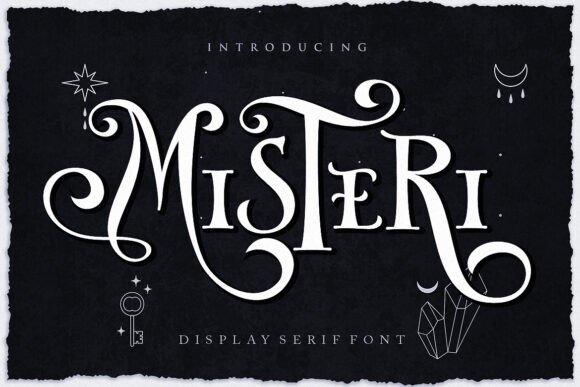
Misteri belongs to a category designers often call display fonts—typefaces built for impact rather than body text. But within that broad family, it occupies a very specific niche. It's a script font with an elegant, almost ethereal quality, yet it avoids the overly casual feel of many handwritten fonts. The letterforms carry a sense of refinement, with delicate strokes that taper gracefully and connections that feel fluid without being sloppy.
What truly distinguishes Misteri, though, is its collection of swashes and ligatures. If you've ever worked with a script typeface that felt flat or repetitive, you know the frustration. Characters start to look mechanical when every "t" connects the same way or every capital letter follows the same arc. Misteri sidesteps this problem entirely. Its alternate characters and decorative extensions give designers the freedom to create letter combinations that feel genuinely handcrafted. A capital "M" at the beginning of a brand name can sweep into an elaborate flourish. A final "y" in a headline can descend into a graceful tail that anchors the entire composition. These aren't afterthoughts—they're integral to how the typeface communicates.
Where Misteri Truly Shines: Real-World Applications
Understanding a font's personality is one thing. Knowing where to deploy it is another. Here's where this premium font earns its place in a designer's toolkit:
- Logo design and brand identity: For businesses in beauty, wellness, luxury goods, artisan food, or entertainment, Misteri offers an immediate sense of sophistication. A bakery called "Velvet Crumb" or a skincare line named "Luna & Sage" would find their visual voice instantly through this typeface. The key is using it for the primary wordmark and pairing it with a clean sans serif font for supporting text.
- Packaging design: Think about the shelf appeal of a product. When someone picks up a box of truffles or a bottle of botanical gin, the typography sets expectations before they read a single ingredient. Misteri's mysterious swashes add a tactile, almost sensory dimension to packaging layouts.
- Social media graphics: Instagram stories, Pinterest pins, and Facebook headers all benefit from typefaces that stop the scroll. Because Misteri reads beautifully at larger sizes, it works exceptionally well for quote graphics, announcement posts, and promotional banners where you need a single phrase to carry the entire visual weight.
- Invitations and event materials: Wedding stationery, gala invitations, product launch announcements—these are contexts where elegance isn't optional. Misteri's ligatures create the kind of flowing, connected text that makes formal invitations feel genuinely special rather than templated.
- Editorial design and blogs: Pull quotes, chapter headings, and featured titles in magazines or lifestyle blogs gain enormous character when set in a typeface like this. It draws the eye without overwhelming accompanying serif fonts or body copy.
- Merchandise and print materials: From tote bags to greeting cards, from poster prints to digital product covers, Misteri adapts to surfaces where a hand-lettered feel adds perceived value.
Pairing Typography Without the Guesswork
One of the most practical questions designers face is how to combine fonts effectively. Misteri, as a decorative script font, naturally works best when it's not competing with another expressive typeface. The general principle is contrast without conflict.
Try pairing Misteri with a geometric sans serif font like Montserrat or Futura for a modern, balanced look. The clean geometry of the sans serif gives the eye a resting place while the script does the visual heavy lifting. Alternatively, a classic serif font like Garamond or Playfair Display can create a more traditional, editorial pairing—think luxury magazine layouts or high-end restaurant menus.
Avoid pairing it with other highly decorative or handwritten fonts. Two expressive typefaces in the same composition tend to create visual noise rather than harmony. Let Misteri be the star, and choose supporting typography that complements without competing.
Readability: The Honest Conversation
Every display font comes with readability trade-offs, and it's worth addressing directly. Misteri is not designed for paragraphs of body text. Its beauty lies in its decorative details—details that become visual clutter when reduced to small sizes or used in long passages.
The sweet spot for this typeface is headlines, short phrases, single words, and display-sized text. At these scales, every swash and ligature has room to breathe. Your audience can appreciate the craftsmanship while still absorbing the message instantly. For body copy, captions, and functional UI text, switch to a legible sans serif font or serif font. This isn't a limitation—it's how modern typography works. Each typeface in your project has a role, and Misteri's role is to create emotional impact at first glance.
Making the Most of Included Styles and Alternates
Before you start a project with Misteri, take time to explore its full character set. Many designers open a font, type their headline, and move on—missing the alternates and ligatures that could elevate their work significantly.
Most professional design assets in this category include multiple stylistic sets. With Misteri, experiment with different capital letter forms. Swap in alternate lowercase connections to see how the rhythm of a word changes. Test which swashes work best for your specific letter combinations—some flourish beautifully on certain characters but feel crowded on others. This exploratory phase takes fifteen minutes but can transform a competent layout into an exceptional one.
Software like Adobe Illustrator, Photoshop, and even Canva Pro now offer access to OpenType features, making it easier than ever to tap into these alternates without advanced technical knowledge.
Licensing and Commercial Use
If you're working on client projects, merchandise for sale, or any commercial application, always verify the font's licensing terms before finalizing your design. A commercial font license typically covers most standard uses—logos, printed materials, digital graphics, and websites. However, some licenses have specific restrictions around embedding fonts in apps, software, or large-scale distribution. Reading the license agreement takes two minutes and prevents headaches later. This is especially important for small business owners who might use a single font across multiple product lines or client deliverables over time.
Choosing the Right Moment for This Typeface
Not every project calls for a font like Misteri, and recognizing that is part of good design judgment. If your brand identity centers on technology, finance, or healthcare, a decorative script might send the wrong signal. But if your work lives in the world of creativity, beauty, storytelling, craftsmanship, or experience—where emotion and aesthetics are part of the value proposition—then a typeface with this much personality isn't just decoration. It's communication.
The best font pairing decisions happen when you start with your project's emotional goal rather than personal preference. Ask yourself: what should someone feel in the first three seconds of seeing this design? If the answer involves wonder, elegance, intimacy, or a touch of mystery, Misteri is worth serious consideration.
Typography shapes perception in ways most audiences never consciously notice. A creative font like this one doesn't just display words—it frames them, gives them texture, and tells your audience something about quality and care before they process the actual message. That quiet power is what makes thoughtful typeface selection one of the most impactful decisions in any visual communication project.